

Agentic AI vs Automation: 2026 Career Disruption
The Shift from Traditional Automation to Agentic AI
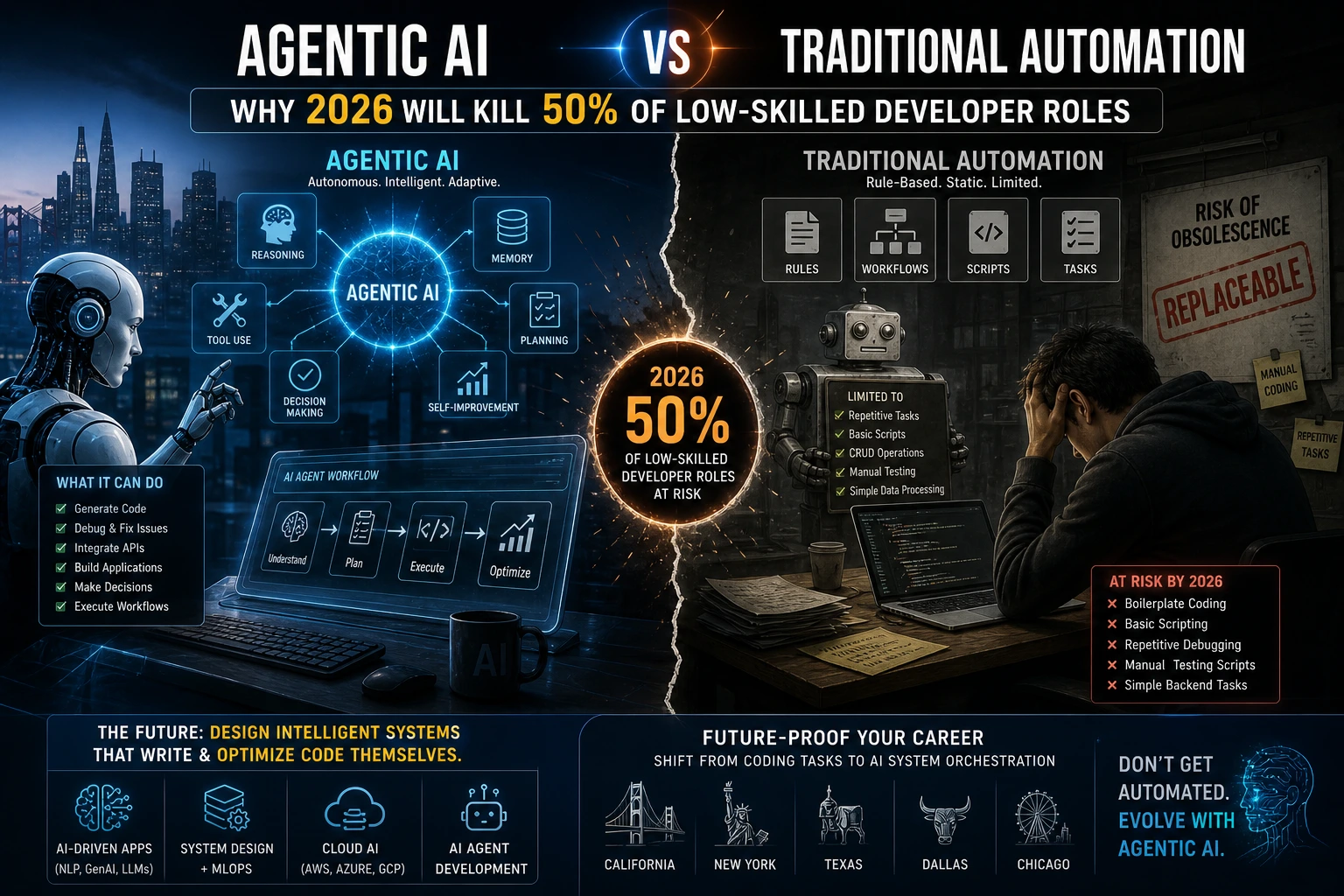
The shift from traditional Automation to Agentic AI is not incremental it is disruptive. Across major US tech hubs like California, New York, Texas, Dallas, and Chicago, hiring trends are rapidly evolving toward Artificial Intelligence, Machine Learning, and high-demand AI Jobs, leaving low-skilled roles in Software Engineering Careers increasingly phasing-out.
Traditional Automation
Rule-Based Logic and Static Workflows
Traditional automation operates on rule-based logic, static workflows, and predefined scripts.
Repetitive Tasks in Traditional Automation
It is limited to repetitive tasks such as:
• Basic backend CRUD operations
• Manual testing scripts
• Simple data processing pipelines
Entry Point Roles for Developers
These roles have historically been entry points for developers, especially for Indian students and professionals targeting:
• Data Science Jobs
• AI Jobs
• Entry-level Software Engineering Careers in the US
Agentic AI
Beyond Traditional Automation
Agentic AI, powered by Generative AI, Machine Learning, and large language models (LLMs), goes far beyond automation.
Capabilities of Agentic AI
It can:
• Generate production-ready code
• Debug applications
• Integrate APIs
• Execute workflows
• Make contextual decisions in real time
Technologies Reshaping AI Engineer Jobs
Frameworks like LangChain, AutoGPT, and AI copilots are already enabling developers to build self-operating systems rather than static applications - reshaping AI Engineer Jobs and Machine Learning Engineer Jobs.
Impact of Agentic AI on Software Engineering Careers
AI Handling Low-Skilled Developer Tasks
By 2026, nearly 50% of low-skilled developer tasks including:
• Boilerplate coding
• Basic scripting
• Repetitive debugging
will be handled by AI Agents, Generative AI, and advanced Machine Learning systems.
Growing Demand for High-Skill AI Jobs
This clearly shows the growing impact of AI on software engineering jobs and the shift toward high-skill AI Jobs in the US market.
Competitive Edge for Developers
Building AI-Driven Applications
For developers in Texas, Dallas, and Chicago and for Indian professionals entering the global workforce the competitive edge now lies in:
• Building AI-driven applications (NLP, Generative AI, LLM applications)
Understanding System Design and MLOps
• Understanding system design + MLOps pipelines
Working With Cloud AI Ecosystems
Working with cloud AI ecosystems like:
• Amazon Web Services (AWS)
• Microsoft (Azure)
• Google (GCP)
Transitioning to AI System Orchestration
• Transitioning from coding tasks to AI system orchestration
The Future of Software Engineering Careers
Intelligent Systems Powered by AI
The future of Software Engineering Careers, Data Science Jobs, and AI Jobs is not about writing more code it is about designing intelligent systems powered by Artificial Intelligence and Machine Learning that can generate, optimize, and scale code automatically.
tag:
Share:
