

How US Working Professionals Are Transitioning into AI & Generative AI Careers Without Leaving Their Current Jobs
Introduction
A silent career transformation is happening across the United States.
In cities like California, New York, Texas, Dallas, and Chicago, thousands of working professionals are transitioning into Artificial Intelligence and Generative AI careers while still working full-time jobs.
This shift is not limited to Software Engineers or Data Scientists.
Product Managers are becoming AI Product Strategists.
Business Analysts are moving into AI Operations.
Consultants are entering AI Transformation roles.
Marketing professionals are building AI-powered growth systems.
Even non-technical professionals are learning AI workflow automation to stay competitive.
The modern workforce has realized one thing:
Artificial Intelligence is no longer just a technology trend. It is becoming a career survival skill and unlike previous technology waves, this transition is happening without people leaving their jobs, pursuing expensive degrees, or taking career breaks.
The Corporate Workforce Is Experiencing an AI Shockwave
AI Is Changing How Companies Operate
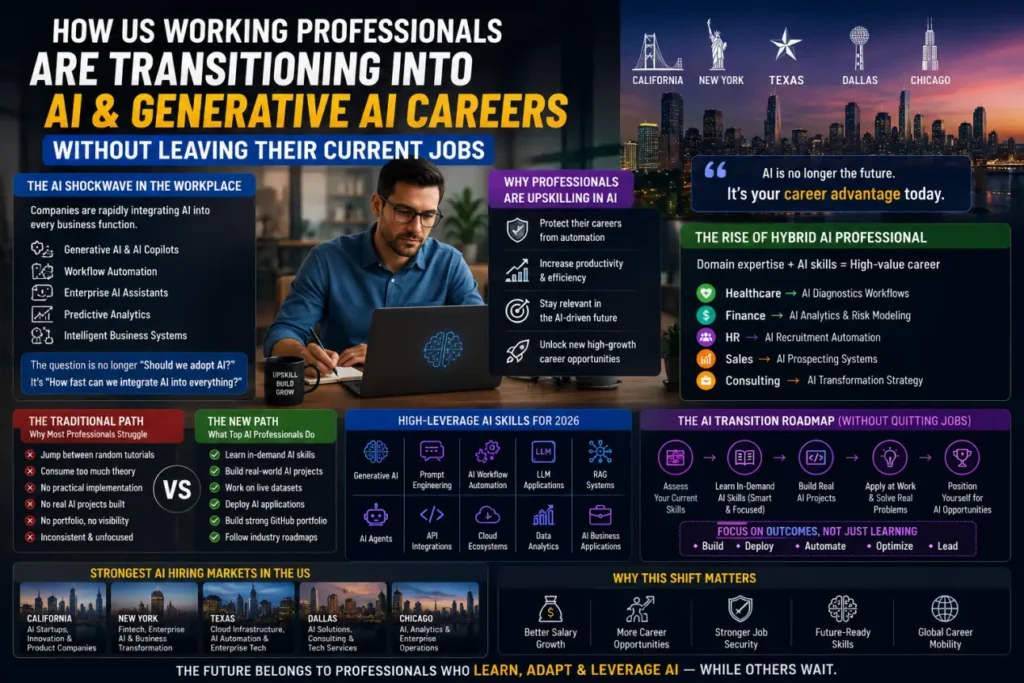
Across the US enterprise ecosystem, companies are rapidly integrating:
• Generative AI
• AI Copilots
• Workflow Automation
• Enterprise AI Assistants
• Predictive Analytics
• Intelligent Business Systems
into day-to-day operations.
This transformation is affecting:
• Hiring Structures
• Productivity Expectations
• Team Operations
• Software Development Workflows
• Customer Support Systems
• Internal Business Processes
Executives are no longer asking:
“Should we adopt AI?”
They are asking:
“How fast can we integrate AI into everything?”
This urgency is creating massive demand for professionals who understand both business systems and Artificial Intelligence workflows.
Why Professionals Are Upskilling into AI Quietly
Most Professionals Understand the Risk
A growing number of working professionals now recognize that many repetitive knowledge-based tasks are becoming partially automated through AI systems.
This includes:
• Reporting Workflows
• Documentation Tasks
• Analytics Operations
• Customer Communication
• Content Generation
• Low-Level Coding
• Operational Processes
As a result, professionals are proactively learning:
• AI Workflow Design
• Generative AI Tools
• Prompt Engineering
• AI Automation Systems
• LLM Applications
• Intelligent Productivity Systems
not necessarily to become researchers - but to remain relevant in the future workforce.
This is one of the biggest reasons AI upskilling has exploded in 2026.
The Biggest Shift: AI Is Becoming a Productivity Multiplier
Companies Want AI-Augmented Professionals
One major misconception is that companies only want “AI Engineers.”
In reality, organizations increasingly want:
• AI-Augmented Managers
• AI-Powered Analysts
• AI-Enabled Consultants
• AI-Aware Developers
• AI-Driven Marketers
• AI-First Operations Professionals
The professionals growing fastest are not always the most technical.
They are the people learning how to use Artificial Intelligence to:
• Automate Workflows
• Increase Output
• Optimize Decision-Making
• Reduce Operational Friction
• Improve Scalability
The future workforce is moving toward AI-enhanced productivity.
Why Generative AI Has Accelerated Career Transitions
Generative AI Reduced the Barrier to Entry
Traditional Machine Learning once required:
• Deep Mathematics
• Advanced Research Knowledge
• Large Engineering Teams
• Expensive Infrastructure
Generative AI changed the landscape completely.
Today, professionals can build:
• AI Assistants
• AI Research Tools
• AI Workflow Automations
• Customer Support Systems
• AI-Powered Dashboards
• Enterprise Copilots
using APIs, no-code workflows, and cloud AI ecosystems. This accessibility is one of the biggest reasons professionals across the US are entering AI Careers faster than ever before.
The Rise of the “Hybrid AI Professional
Domain Expertise Is Becoming Extremely Valuable
One of the most important hiring trends in 2026 is the rise of hybrid professionals.
Companies increasingly prefer individuals who combine:
Industry Expertise
• Operational Understanding
• Business Communication
• AI Implementation Skills
instead of purely theoretical AI specialists.
For example:
• Healthcare Professionals Are Learning AI Diagnostics Workflows
• Finance Professionals Are Implementing AI Analytics Systems
• HR Teams Are Adopting AI Recruitment Automation
• Sales Teams Are Using AI Prospecting Systems
• Consultants Are Designing AI Transformation Strategies
The market is rewarding professionals who can apply AI inside real business environments.
Why Many Professionals Are Choosing Structured AI Programs
Self-Learning Alone Is Becoming Difficult
The AI ecosystem is evolving extremely fast.
Many professionals struggle because they:
• Jump Between Random Tutorials
• Consume Too Much Fragmented Content
• Lack Implementation Direction
• Never Build Practical Systems
• Fail to Stay Consistent While Working Full-Time
This is why practical AI mentorship ecosystems, implementation-focused bootcamps, and project-driven learning communities are growing rapidly among US professionals.
The strongest AI learners today are not the people watching endless content.
They are the professionals consistently building practical AI workflows while applying them to real business problems.
What Skills Professionals Are Prioritizing in 2026
High-Leverage AI Skills
Professionals transitioning into AI Careers are increasingly focusing on:
• Generative AI Workflows
• Prompt Engineering
• AI Productivity Systems
• AI Workflow Automation
• LLM Applications
• API Integrations
• Retrieval-Augmented Generation (RAG)
• AI Agents
• Cloud AI Ecosystems
• AI Business Applications
The demand for these skills is growing across almost every industry sector.
Why AI Career Transitions Will Accelerate Further
AI Is Becoming Part of Every Industry
Artificial Intelligence is no longer isolated to technology companies.
Organizations across:
• Healthcare
• Banking
• Logistics
• Consulting
• Retail
• SaaS
• Education
• Manufacturing
are integrating AI systems into core operations.
As adoption increases, professionals without AI exposure may face slower career growth compared to individuals capable of working alongside intelligent systems.
The workforce is slowly dividing into:
• AI-Enabled Professionals
• Professionals Being Replaced by AI-Enabled Systems
Key Takeaways
• US Professionals Are Transitioning into AI Careers Without Quitting Full-Time Jobs
• Generative AI Has Reduced Barriers to Entering Artificial Intelligence Roles
• AI Is Becoming a Productivity Multiplier Across Industries
• Companies Increasingly Prefer Hybrid AI Professionals with Domain Expertise
• AI Workflow Automation Skills Are Becoming Highly Valuable
• AI Upskilling Is Now Driven by Career Survival and Long-Term Growth
• Practical Implementation Matters More Than Passive Certifications
• AI-Native Professionals Will Dominate Future Workforce Transformation
Conclusion:
The future of work is no longer about competing against Artificial Intelligence.
It is about learning how to work with it.
In 2026, the professionals growing fastest are not necessarily those with the most degrees or technical certifications. They are the individuals strategically integrating AI into their workflows, industries, and decision-making systems.
The AI revolution is creating a new generation of professionals:
not just software engineers,
but AI-enhanced operators, consultants, strategists, builders, and business leaders.
The professionals who adapt early will shape the next decade of the global workforce.
Call To Action (CTA)
Artificial Intelligence is no longer optional for long-term career growth.
Professionals who begin learning Generative AI, AI Automation, and intelligent workflow systems today will gain a major competitive advantage in future leadership opportunities, consulting ecosystems, salary growth, and career stability.
The future belongs to professionals who learn how to leverage AI - not ignore it.
FAQ Section
tag:
Share:
