

The Portfolio Illusion: Why Recruiters Ignore Most Student AI Projects in 2026
Introduction
Across India and major technology hubs such as California, New York, Texas, Dallas, and Chicago, thousands of engineering students are building Artificial Intelligence, Machine Learning, Data Science, and Generative AI projects to improve their chances of securing internships, Placements, and AI Jobs.
Many students believe that simply adding multiple projects to their GitHub profile automatically makes them job-ready.
Unfortunately, recruiters see things differently.
In 2026, companies are receiving thousands of applications from candidates claiming experience in Artificial Intelligence, Machine Learning, Data Science, Generative AI, AI Agents, and LLM Applications. As a result, recruiters have become highly effective at identifying the difference between genuine engineering capability and copied project work.
This has created what can be called the Portfolio Illusion.
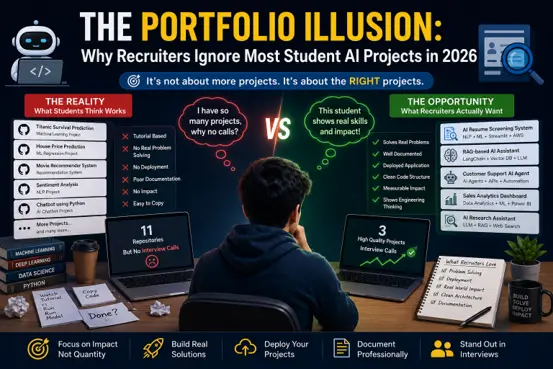
Students assume they have a strong AI portfolio because they completed several projects. Recruiters often see a collection of tutorials, cloned GitHub repositories, and projects that demonstrate very little real-world engineering ability.
The challenge facing students today is not building more projects.
The challenge is building projects that actually matter.
Understanding the Portfolio Illusion
More Projects Do Not Mean Better Opportunities
One of the biggest misconceptions among students is that quantity creates credibility.
Many portfolios contain:
• 10 Machine Learning Projects
• 5 Data Science Dashboards
• 3 AI Chatbots
• Multiple Certifications
Yet recruiters often reject these candidates within minutes.
The reason is simple.
Most projects fail to demonstrate:
• Problem-Solving Ability
• System Design Understanding
• Deployment Knowledge
• Engineering Thinking
• Real-World Application
A portfolio filled with copied work rarely creates competitive advantage.
The Internet Has Made Basic Projects Common
Today almost every student can build:
• Titanic Prediction Models
• House Price Prediction Systems
• Movie Recommendation Projects
• Basic Chatbots
• Sentiment Analysis Applications
These projects were impressive several years ago.
In 2026, they have become extremely common.
Recruiters evaluate hundreds of similar portfolios every month.
The result is that basic projects no longer differentiate candidates.
Why Recruiters Ignore Most AI Projects
Tutorial Projects Are Easy to Identify
Modern recruiters and hiring managers can quickly identify tutorial-based projects.
Common indicators include:
• Identical Project Structures
• Copied Documentation
• Generic Datasets
• Standard Outputs
• Lack of Customization
Many candidates struggle when recruiters ask:
• Why Did You Choose This Architecture?
• What Challenges Did You Face?
• How Would You Improve the System?
• What Business Problem Does It Solve?
The inability to answer these questions immediately signals a lack of ownership.
Most Projects Never Reach Production
One major problem is that students stop once the model works.
Real engineering begins after that stage.
Companies increasingly care about:
• Deployment
• Scalability
• User Experience
• APIs
• Monitoring
• Performance Optimization
A Machine Learning model running inside a notebook has limited value.
A deployed application solving a real problem has significantly greater impact.
What Recruiters Actually Want to See
Projects That Solve Real Problems
The strongest portfolios focus on solving meaningful problems rather than showcasing algorithms.
Examples include:
• AI Resume Screening Systems
• Interview Preparation Assistants
• AI Research Assistants
• Customer Support Automation Tools
• AI-Powered Analytics Platforms
• Business Process Automation Systems
Recruiters value relevance more than complexity.
Demonstrated Engineering Thinking
Companies increasingly hire developers who can think beyond coding.
Strong portfolios demonstrate:
• Architecture Decisions
• Workflow Design
• Deployment Strategies
• Scalability Planning
• Problem-Solving Methodology
These qualities signal future engineering potential.
The Rise of Generative AI Portfolios
Traditional Projects Are Losing Attention
The rapid growth of Generative AI is changing portfolio expectations.
Organizations are increasingly interested in projects involving:
• Large Language Models (LLMs)
• Retrieval-Augmented Generation (RAG)
• AI Agents
• Prompt Engineering
• AI Workflow Automation
• Vector Databases
• LangGraph Workflows
Students who build these systems often stand out because they demonstrate familiarity with emerging technologies.
AI Agents and RAG Applications Are Creating New Opportunities
Many companies are actively exploring:
• AI Assistants
• Knowledge Retrieval Systems
• Autonomous AI Workflows
• Enterprise Search Solutions
• Multi-Agent Systems
Projects in these areas align more closely with current hiring trends than traditional academic projects.
Why GitHub Alone Is Not Enough
Visibility Without Quality Has Limited Value
Many students focus heavily on GitHub activity.
While GitHub is important, recruiters care more about:
• Project Quality
• Documentation
• Deployment
• Usability
• Business Relevance
A portfolio with three exceptional projects often outperforms one containing twenty unfinished projects.
Documentation Matters
Strong projects explain:
• The Problem
• The Solution
• The Architecture
• The Technology Stack
• Implementation Challenges
• Future Improvements
Good documentation demonstrates professionalism and communication skills.
What Makes an AI Portfolio Industry-Ready
Build End-to-End Applications
Students should focus on creating complete systems that include:
• Frontend Interfaces
• Backend APIs
• Databases
• AI Models
• Deployment Environments
This demonstrates the ability to build production-ready applications.
Show Real-World Impact
Recruiters are increasingly interested in measurable outcomes.
Projects become more valuable when they demonstrate:
• Time Savings
• Process Automation
• Decision Support
• Business Efficiency
• User Engagement
Impact creates stronger interview discussions and portfolio credibility.
How Students Can Build Better AI Projects in 2026
Focus on Depth Over Quantity
Instead of building ten basic projects, students should build three strong projects that showcase:
• Artificial Intelligence
• Machine Learning
• Generative AI
• Cloud Deployment
• API Integration
• Problem Solving
Quality always outperforms volume.
Build Like an Engineer
Type your paragraph here
Students should approach projects as products rather than assignments.
This means considering:
• Users
• Scalability
• Performance
• Deployment
• Maintainability
This mindset dramatically improves portfolio quality.
Key Takeaways / Bullet Points
• Most AI Portfolios Fail Because They Prioritize Quantity Over Quality.
• Recruiters Can Quickly Identify Copied Tutorial Projects.
• Basic Machine Learning Projects No Longer Create Strong Differentiation.
• Companies Increasingly Value Deployment and Real-World Implementation.
• Generative AI, AI Agents, and RAG Applications Are Becoming Portfolio Advantages.
• GitHub Activity Alone Is Not Enough to Impress Recruiters.
• Strong Documentation Improves Project Credibility.
• End-to-End Applications Demonstrate Real Engineering Ability.
• Industry-Ready Portfolios Focus on Solving Meaningful Problems.
• The Future Belongs to Builders Who Can Create Practical AI Solutions.
Conclusion
The biggest mistake students make in 2026 is assuming that every project adds value to their portfolio.
Recruiters are no longer impressed by project quantity, copied implementations, or tutorial-based applications.
The hiring market is increasingly rewarding students who can solve real problems, build deployable systems, and demonstrate genuine engineering capability.
As Artificial Intelligence, Data Science, Machine Learning, and Generative AI continue transforming the technology industry, portfolio quality will become one of the strongest indicators of career readiness.
Students who focus on building meaningful, practical, and industry-relevant projects will create opportunities that certificates alone cannot provide.
Call To Action (CTA)
Your portfolio is often your first interview before the actual interview.
If you want to stand out in AI Jobs, Data Science Careers, Machine Learning Engineer roles, and Generative AI opportunities, focus on building projects that solve real-world problems and demonstrate practical engineering skills.
The best portfolio is not the one with the most projects.
It is the one that proves you can build something valuable.
FAQ Section
tag:
Share:
