


The Death of Entry-Level Tech Jobs: What Developers Must Learn Before 2027
Introduction
Across major US technology markets such as California, New York, Texas, Dallas, and Chicago, the demand for traditional entry-level software development roles is rapidly declining. The rise of Artificial Intelligence (AI), Machine Learning, Generative AI, AI Automation, and AI-assisted software engineering tools is fundamentally reshaping Software Engineering Careers and Data Science Jobs across the global technology industry.
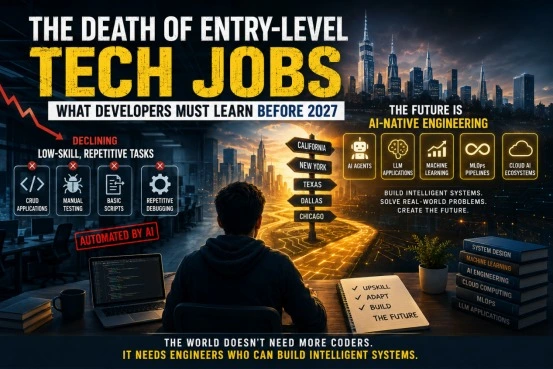
For years, junior developers built careers through repetitive engineering tasks such as frontend templating, CRUD application development, manual testing, debugging, and basic API integrations. However, modern AI systems powered by Large Language Models (LLMs), AI Agents, and autonomous development workflows are increasingly automating these responsibilities at scale.
As a result, companies are shifting hiring priorities toward engineers capable of building intelligent systems, scalable AI infrastructure, cloud-native architectures, and real-world Machine Learning applications.
Why Entry-Level Tech Jobs Are Disappearing
AI Automation Is Replacing Repetitive Development Tasks
Modern Artificial Intelligence systems can now generate code, automate testing, optimize debugging workflows, and accelerate deployment pipelines. AI-powered coding assistants and Generative AI tools are reducing dependency on traditional low-complexity software engineering tasks.
Companies Are Prioritizing AI-Driven Engineering Roles
Technology companies across California, New York, Texas, Dallas, and Chicago are aggressively hiring professionals skilled in:
• Artificial Intelligence
• Machine Learning
• Generative AI
• AI Agents
• Cloud AI ecosystems
• MLOps pipelines
• Data Science and analytics infrastructure
This transformation is redefining AI Jobs, Machine Learning Engineer Jobs, and Software Engineering Careers in 2027.
What Developers Must Learn Before 2027
AI-Native Engineering Skills
The future belongs to engineers who can design and deploy intelligent systems. Companies increasingly expect developers to understand:
• Machine Learning pipelines
• LLM applications and AI orchestration
• Vector databases and retrieval systems
• Cloud AI ecosystems (AWS, Azure, GCP)
• Real-time analytics and autonomous AI workflows
• MLOps deployment infrastructure
System Design + AI Integration
Traditional coding alone is no longer enough.High-growth engineers must combine:
• Backend engineering
• Distributed systems
• API orchestration
• AI model deployment
• Scalable cloud infrastructure
• Generative AI workflows
The industry is moving toward a new category of professional: the AI-native engineer.
Why Indian Developers Must Adapt Quickly
US Tech Hiring Is Rapidly Changing
Recruiters in California and New York increasingly prioritize engineers capable of combining Software Engineering with Artificial Intelligence and Machine Learning capabilities.
Meanwhile, enterprise companies in Texas, Dallas, and Chicago are investing heavily in AI-powered automation systems and scalable intelligent architectures.
Tutorial-Based Learning Is Becoming Obsolete
One of the biggest mistakes developers make is relying only on tutorial-based learning and low-complexity portfolio projects. Companies now prioritize:
• Production-ready AI applications
• Real-world Machine Learning systems
• Cloud-native AI platforms
• End-to-end AI product development
• Deployable Generative AI workflows
Developers who fail to adapt to this AI-driven transformation risk becoming increasingly irrelevant in the future technology ecosystem.
Key Takeaways / Bullet Points
• Entry-level tech jobs are rapidly changing due to Artificial Intelligence and Automation
• AI-assisted software development is replacing repetitive coding workflows
• AI Jobs and Machine Learning Engineer Jobs are growing faster than traditional developer roles
• Developers must learn Generative AI, LLM applications, and MLOps pipelines
• Cloud AI ecosystems such as AWS, Azure, and GCP are becoming critical skills
• Companies increasingly prefer AI-native engineers over traditional low-skill developers
• Indian students targeting US technology careers must focus on practical AI skills and scalable systems
Conclusion
The future of Software Engineering Careers is no longer centered around writing static application code. By 2027, the most valuable engineers will be those capable of building intelligent systems that learn, automate, optimize, and operate autonomously through Artificial Intelligence and Machine Learning infrastructure.
The next generation of successful developers will not simply be programmers. They will be AI-native engineers capable of designing scalable intelligent ecosystems for the future global technology economy.
Call To Action (CTA)
Developers who start building practical AI, Machine Learning, and Generative AI skills today will have a major competitive advantage in the future hiring market.
The future belongs to engineers who build intelligent systems, not just applications.
FAQ
tag:
Share:
