


AI vs Software Engineering: Which Career Will Dominate in California, New York & Texas by 2026?
Introduction
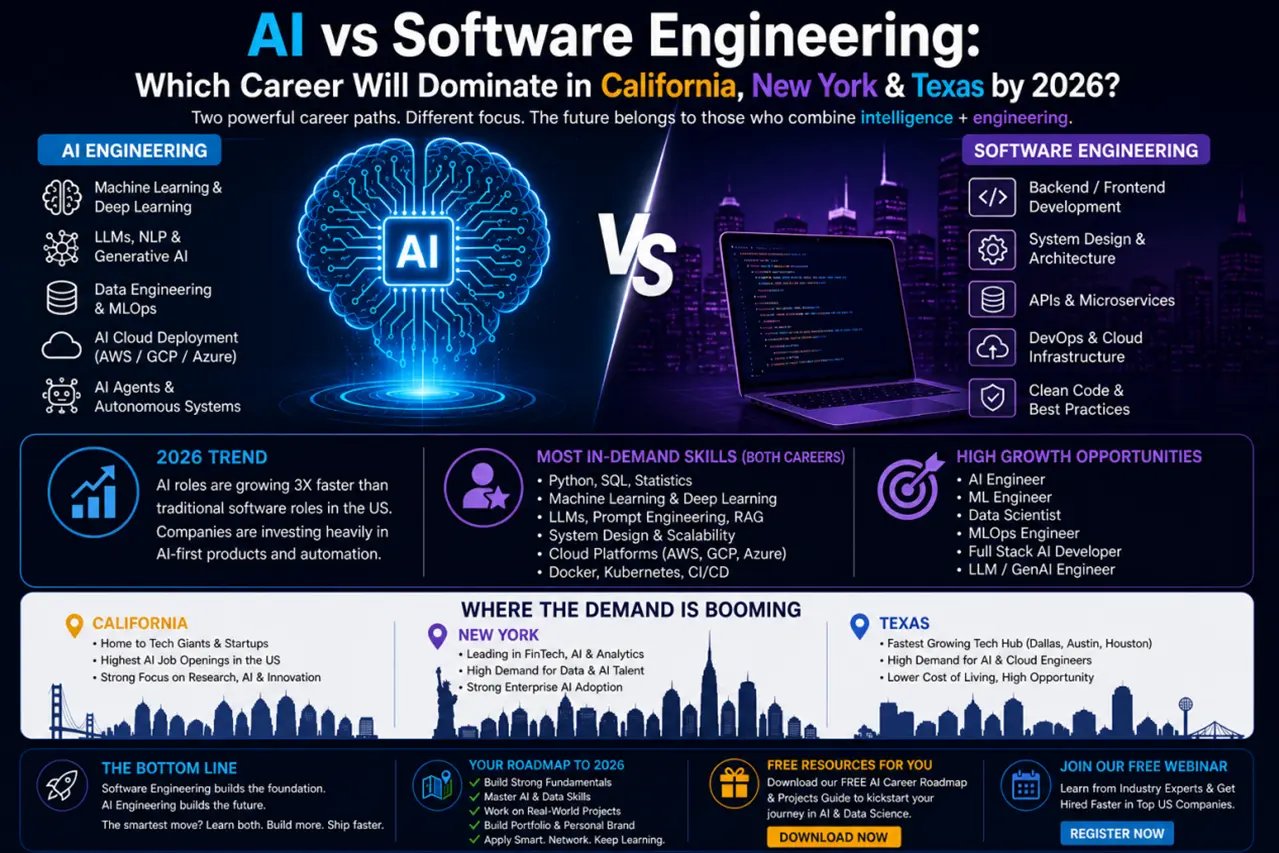
The debate around Artificial Intelligence vs Software Engineering is no longer theoretical, it is becoming one of the most important career decisions for developers targeting the US tech market. Across major tech hubs like California, New York, and Texas, hiring trends are rapidly shifting toward AI Jobs, Machine Learning Engineer Jobs, and AI-native engineering roles that combine traditional software development with intelligent systems design.
Traditional Software Engineering Careers focused on backend systems, APIs, databases, and microservices still remain essential to modern infrastructure. However, the rise of Automation, Generative AI, AI-assisted development workflows, and low-code platforms is reshaping the future of entry-level developer roles.
At the same time, demand for Artificial Intelligence, Machine Learning, Data Science, and AI Engineer Jobs continues to grow aggressively as companies invest heavily in intelligent systems, LLM applications, AI Agents, and enterprise AI infrastructure.
The Current State of Software Engineering Careers
Traditional Software Engineering Still Powers Modern Infrastructure
Software Engineering remains the backbone of the technology industry. Modern enterprises still depend on scalable distributed systems, backend architectures, APIs, cloud-native applications, and microservices to run global platforms.
Core areas still driving Software Engineering Careers include:
• Backend Development
• Cloud Computing
• DevOps & Infrastructure Engineering
• Distributed Systems
• Cybersecurity Engineering
• API Development
• Enterprise Application Development
Why Entry-Level Software Engineering Roles Are Becoming Competitive
While demand for experienced engineers remains strong, entry-level software engineering jobs are becoming increasingly saturated. AI coding assistants, automation tools, and Generative AI systems can now automate repetitive development tasks such as:
• CRUD Application Development
• Basic Frontend Implementation
• Standard API Generation
• Unit Testing Automation
• Documentation Generation
• Debugging Assistance
Developers relying only on traditional coding skills may face increasing competition in the coming years.
The Rise of Artificial Intelligence Careers
Why AI Jobs Are Growing Faster Than Ever
The rapid adoption of Artificial Intelligence across industries has created explosive demand for:
• AI Engineer Jobs
• Machine Learning Engineer Jobs
• Data Science Jobs
• MLOps Engineer Roles
• Generative AI Engineer Positions
• AI Research Careers
Companies are actively building AI-first products capable of learning, reasoning, automating workflows, and generating intelligent outputs.
Technologies Driving AI Career Growth
Modern AI-driven systems require expertise in advanced technologies such as:
• Large Language Models (LLMs)
• Retrieval-Augmented Generation (RAG)
• Vector Databases
• LangChain Frameworks
• Autonomous AI Agents
• Real-Time Analytics Systems
• Cloud AI Infrastructure
Developers are increasingly expected to build systems capable of intelligent decision-making and automation at scale.
The Evolution of the AI-Native Software Engineer
The Future Belongs to Hybrid Engineers
The highest-paying tech careers are no longer purely Software Engineering or purely Artificial Intelligence roles. Instead, employers are prioritizing hybrid engineers who understand both domains.
The modern AI-native software engineer combines:
• Backend Engineering
• Cloud Infrastructure
• Machine Learning Integration
• AI Workflow Automation
• Distributed Systems Design
• MLOps Pipelines
• Intelligent API Orchestration
This convergence is becoming the new industry standard.
What Companies Expect by 2026
By 2026, companies across California, New York, and Texas are expected to prioritize developers capable of building intelligent production systems rather than traditional standalone applications.
Future-ready engineers will need expertise in:
• AWS, Azure & Google Cloud AI Services
• Production-Scale AI Deployment
• LLM-Powered Applications
• Scalable AI Infrastructure
• Autonomous Workflow Systems
• Enterprise AI Integration
The future of Software Engineering Careers is increasingly tied to Artificial Intelligence and Automation.
Key Takeaways
• Artificial Intelligence Jobs are growing faster than traditional entry-level developer roles
• Software Engineering remains essential for scalable infrastructure and backend systems
• AI-Assisted Development is transforming coding workflows
• Machine Learning, Generative AI & AI Agents are becoming core enterprise technologies
• Hybrid AI-Native Software Engineers will dominate high-paying tech careers by 2026
• Indian Professionals targeting US tech jobs should focus on combining AI & Software Engineering skills
Conclusion
The future is not simply Artificial Intelligence vs Software Engineering. The real transformation lies in the evolution of Software Engineering through Artificial Intelligence, Automation, and intelligent system orchestration.
Traditional coding alone may no longer be enough in the rapidly changing US technology market. Developers who combine backend engineering expertise with Machine Learning, Generative AI, cloud infrastructure, and intelligent automation systems will be positioned for long-term career growth.
As companies continue investing in AI-first products and intelligent enterprise systems, the next generation of developers must evolve into AI-native engineers capable of building scalable, autonomous, and intelligent production platforms.
Call To Action (CTA)
Want to become job-ready for the future of AI and Software Engineering?
Start learning:
• Artificial Intelligence
• Machine Learning
• Generative AI
• Cloud Computing
• MLOps
• Backend Engineering
• AI Agent Development
• LLM Application Development
The next wave of US tech hiring will favor developers who can build intelligent systems—not just write code.
FAQ Section
tag:
Share:
